Pages

Sunday, 26 February 2017

Seleucid Showcase: Greek Auxilary Foot


Thureophoroi, Thorakitai, Thracians, and Cretans protect the elephants and flank of the phalanx.

Along with their Asiatic auxiliaries, the Seleucids and other Successors made good use of their 'Greek' allies, although the word 'Greek' is used in its widest sense here.

So these are all Frei Korps 15mm and form part of my Seleucid army, and the sheer majority of which were painted by Le Chasseur.

Thureophoroi

So called because of the name of their oval shields - the Thureos - these troops seemed to have developed from the Greek Peltasts - named because of the name of their shields, the Pelte.

These were sometimes very good auxiliary troops, lighter than the phalanx and who fought in similar but shallower ranks and files, with javelins, short spears, and sword.


Thorakitai

Thought to be a heavier version of the Thureophoroi, these troops seemed to have fulfilled a similar function but were generally armed with a long thrusting spear and chain-mail armour.

Although there seems to be some confusion now as to whether these were actually separate class of troops who just happened to carry the Thureos, or even whether they existed at all - meh.

Both types of auxiliary seemed to have evolved into what could best be considered 'Roman-like' Hastati and Princepes, as the later part of the Successor period overlapped with the Roman Republic.

Still these are good looking troops of which I only have half painted... what? Its only been 20 years!

Thracians

Next door neighbours with the Macedonians in the kingdom of Thrace, these guys were considered hardy and aggressive troops on the whole.
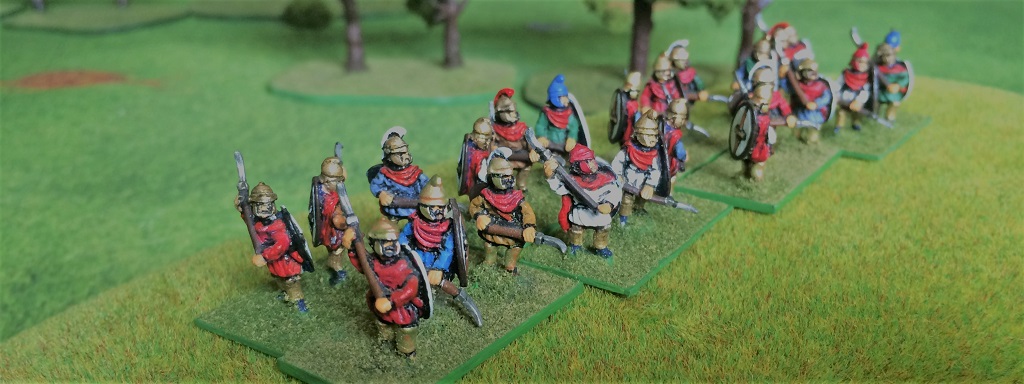

There were generally two types of heavier Thracian auxiliary used in the Successor armies. One type was armed similarly as the Thureophoroi, the other - as are all these troops - were armed with the vicious Rhomphaia - basically a curved blade on a stick,


These guys saw service throughout the ancient world of the associated period.

Cretans

Sourced from Crete, these archers were considered some of the best in the ancient world and would turn up as mercenaries in many countries' armies until well into the medieval period.


So no self respecting ancients general of lead and plastic should be without these guys in their armies!

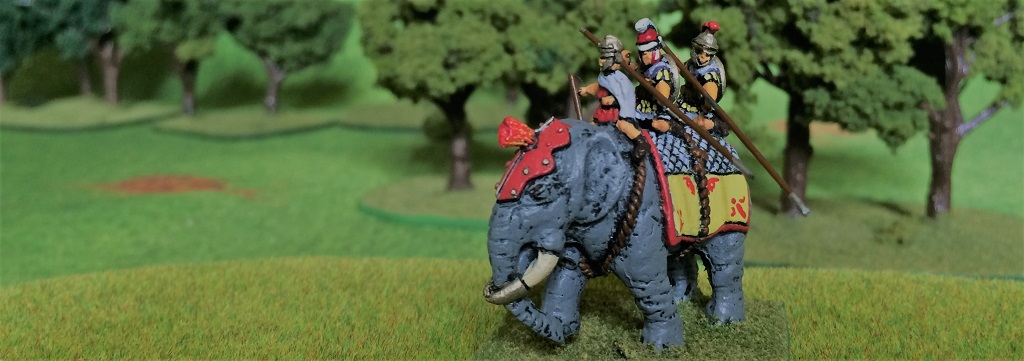
Seleucid Showcase: Elephants


Any player who says that it wasn't the enormous numbers of elephants available to this army in most rule sets, which made them game it, is either lying or hasn't read the associated army list properly.

This post showcases the 15mm Frei Korps elephants available in my Seleucid army.


Seleucid Elephants


These guys are really nice multi-part figures which I can remember building and painting.


I think the elephant without the Seleucid armour is in fact listed as a Macedonian elephant with howdah.


Macedonian Elephant


An earlier version of the Macedonian elephant without howdah, still feasible in a Successor army.


My favourite rule of the last 20 years for these guys was the Stampede rule in WAB. Upset the elephant enough with javelins or arrows and off it would go, I scatter die and 2d6cms later, you'd be amazed what they bumped into!

Seleucid Showcase: Asiatic Auxilary Foot


Asiatic auxiliaries flank the phalanx.

The Seleucid and Successor armies employed fairly large numbers of lighter troops to support the phalanxes, elephants, and heavy cavalry.

This post showcases the 15mm Frei Korps troops that were drawn from the lands conquered during Alexander's times, which would have been the local population of the Eastern Successor States.

Asiatic Bow


With origins from the Persian armies like those of Darius, Asiatic bowmen often provided the bulk of auxiliary foot troops.


These bowmen functioned as dedicated 'massed' bowmen (above) and as light troops or skirmishers (below). They were of varying quality ranging from poor to good.


If memory serves correctly, Le Chasseur painted these guys up as part of a commission - nice job!


Galatians


One of the many marauding bands of 'Celtic barbarians', the nomadic Galatians were hired to provide more of a punch than other auxiliaries, functioning much like aggressive Celts on too much sugar.


The Galatians often armed themselves with the spoils of battle and the FK bags reflect the expected mix of equipment nicely.


Kappadokian Hillmen


Often used to 'bulk out the numbers', hilltribes were often mustered into the Successor armies.


These were generally sound troops that could function well as skirmishes.


Again I think these hillmen were a commission painted by Le Chasseur.

Selecucid Showcase: The Phalanx


Close up shot - great figures for 15mm.

Here's the phalanx finished so far from my 15mm Frei Korps Seleucid/Successor army.


A mix of Macedonian and Successor phalanx blocks, but no Asiatic blocks - they were too dismal on the field!


These figures produce a great 'heghog of spears' effect. The Sarisas themselves are made from piano wire.


Shot of the detail on the back of these figures.


Generally, after many bags of figures were purchased, I tried to stick to the rule of thumb for the phalanx soldiers. Richer and more experienced soldiers would be at the front of the phalanx in full panoply (suit of armour) and poorer less well equipped soldiers would be at the back.

The FK bags of Phalangites allowed the individual blocks to have a mix of equipment; the back two ranks wearing only tunics.

PS: It now looks as though the FK phalangite range is no longer available, at least its not listed in the TTS/QRF Macedonian/Successor product range. This is a real shame as these figures paint up well. I have two blocks still to paint up... of perhaps the last ones on the planet!?

Argyraspides - Silver Shields


The elite phalanx unit on the field along with their mounted equivalents the Companions.


Perfect block to include the outstanding FK pike general figure.


Macedonian Phalanx


Complete with bright blue Phrygian helmet and often referred to by players as smurfs.


Two blocks of Macedonians the elite unit (below) - purple theme and regulars with rose tunics (above).


They certainly make a colourful couple of blocks.


A good example of the mix of panoply equipment in the FK bags.


Successor Phalanxes
Some liberty taken with these units, based on the Macedonians and assumed to be fairly well equipped with their own unit colours.


This unit also has one of the FK generals attached.


There's a crimson helmet lying on the floor of one of the plates in the Osprey book I used as a reference for this army - couldn't resist a unit made up with this helmet.


This is a well outfitted veteran unit with full panoply for all ranks, but not all the Phalangites could afford or had earnt the right to wear a pulme - the mix of figures in the KF bags allow for this nuance.


One of the poorer regular units, no plumes on their helmets and a mix of panoply.


That's it so far. Its only been 20 years and think I still have one or two blocks to paint up.

But seems rules nowadays only require two ranks instead of the blocks of four of old... oh well.

Saturday, 25 February 2017

Epic Ultramarine - Updated Pics


Noticed that my Ultramarine army posts were getting some attention and realised I hadn't updated the pics, which were too dark and lacking detail when I brought them over from the last blog site.

So here are all the posts, with all new - but still not great - pics:

1st Company - Terminators and Veterans

2nd Company - Tactical, Devastator, and Assault Platoons (Rhinos)

3rd Company - Tactical, Devastator, and Assault Platoons  (Drop Pods)

6th, 7th, 9th & 10th Companies - Bikes, Speeders, Devastators, and Scouts

Ultramarines & Imperial Navy - Aerospace Units

Legion Support - Predators, Razorbacks, Whirlwinds, Hunters... More Rhinos

Titan Legion - Warlord, Reavers, Warhounds


Tuesday, 7 February 2017

AWI: TRAIN!


After a short break while prospecting for contracts and while prepping the next units of Continentals, I spied a small plain box on top of some other boxes and remembered the artillery I'd purchased years ago: it almost screamed 'next project' to me and I caved.

Having read the PSR reviews of IMEX's American and British AWI artillery sets, I decided that I wouldn't use the guns because of their small size and likely inaccuracy - historical that is. I went looking for 20mm AWI or SYW guns on the Interweb and lo and behold, found Lancer Miniatures SYW 20mm range.

British Train: Lancer Miniatures 12pdrs, 6pdrs, and battalion guns (3pdrs).

Mindful of the BP: Rebellion! supplement commentary, regarding the need for only small numbers of artillery necessary for the period, I soundly ignored it and bought twelve British guns of varying size - to be used by the Brits and the Americans.


A veritable tiny artillery park began forming on my coffee table.

Mindful also of the raft of metals that have gone before, I sat down in front of the TV thinking I'd have hours of filing and prepping to do. But Lancer Miniatures, you provided me with some of the best cast and cleaned metal figures I have ever received - including Games Workshop. All's the preparation took was superglue and whisky. Big thumbs up to Lancer.

Really like the detail on these guns and went for a mid-battle/dirty look to them.

Then as I looked at the boxes of plastic artillery I decided to have a peek and see how they compared to Lancer's stuff. Half an hour later I'd prepped the three 3 pounders from Revell Set 02579 Austrian Artillery and the four 'battalion' sized guns from the IMEX Set 554 American Artillery for use in the American camp. Comparing them to the accurate metals, they look more like 4-6 pounders and 3 pounders respectively.

Then I got stuck having bitten off too much to chew and while trying to find another contract, and the minis just sat on the table for a few weeks, the undertaking getting larger and larger in my head until I decided to concentrate on writing some sci fi rules as a mode of further procrastination.

The veritable tiny artillery park got bogged down in procrastination - why did I undercoat them all Olive Drab?

For the paint schemes there was nothing overly clever about them. I stuck to British light grey and American (barn) red, iron for fastenings and brass for barrels. A mix of dry brushing for the wood and washes around the iron and brass work.

American Train: Plastic fantastics from Revell and IMEX, plus Lancer 12pdrs nicked from the British lines.

At a push each side can be fielded with four battalion guns, three or four 6 pdrs, and two 12 pdrs - far too many for a balanced game of BP that doesn't involve an artillery park or fort in the scenario.

Still going for the mid-battle/dirty look, this paint scheme was harder than it looked.

Now I've just got to paint up some crews.